
Introduction—Golden Fields and Global Impact
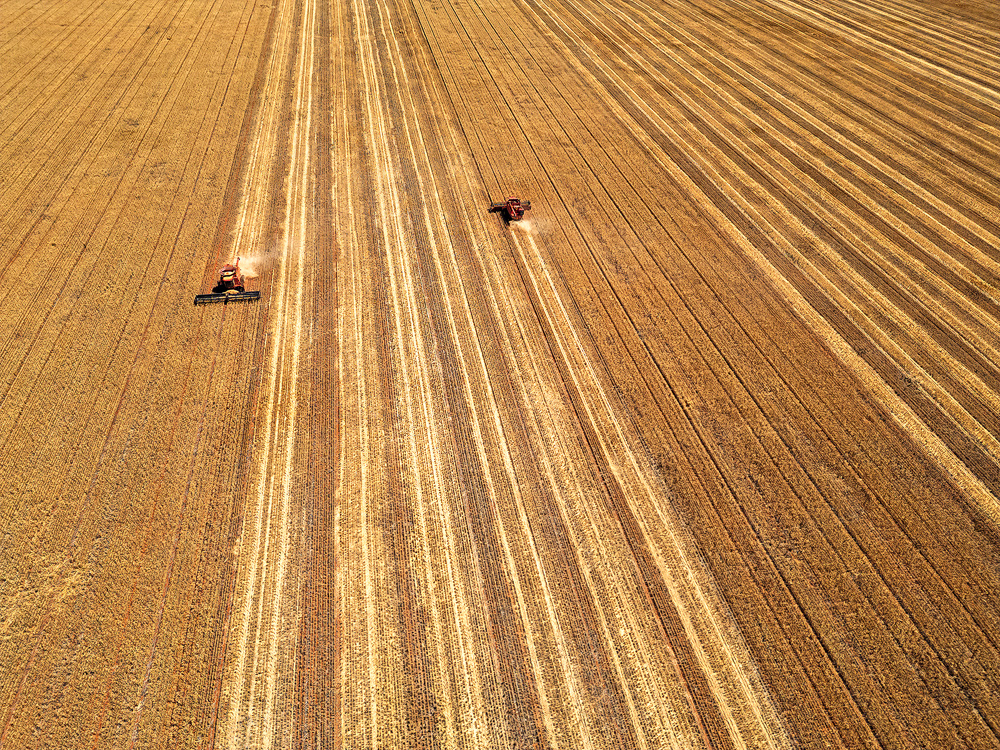
Golden fields, long days, and the hum of harvest—there’s nothing quite like wheat season in the Outback. We’re excited to be back at Callubri Station for another ‘Skill Swap’ opportunity, documenting the 2025 wheat harvest in images, video, and words.
Authentic storytelling starts with understanding the ‘why’ behind the work. For me, that ‘why’ is about bridging the disconnect between city folk and the regional communities that grow our food and power our daily lives. At a time when so many travellers flock to places popularised on Instagram, I’m choosing to invest in relationships—the kinds that open doors to unique, unseen stories.
Wheat isn’t just another crop in Australia—it’s the heart of vast, golden landscapes and a cornerstone of the farming economy. Each year, across a 12-million-hectare grain belt stretching from Western Australia to the Eastern States, farmers bring in roughly 25–28 million tonnes of wheat. But here’s the twist: although wheat is a staple in Australian kitchens, most of what’s grown here doesn’t stay here. Around two-thirds—65 to 75 percent—is exported overseas, making up a significant slice of the global wheat trade1.
While I’m excited to capture the dusty dance of chaser bins and the aerial views of harvesters carving their way through endless golden paddocks, this project isn’t just about beautiful images. It’s about documenting a moment in a global food story—a massive, coordinated effort that feeds people and supports livelihoods around the world. The wheat harvested here will become bread, cakes, and noodles in places as far-flung as Yemen, South Korea, China, and New Zealand. Few of those consumers will ever think about the stories behind the labour, grit, and timing that went into the bowl of pho they’re enjoying.
We arrived late in the day on a Sunday, with instructions to find our way to a paddock on the outskirts of the property where the story between people, machinery, and wheat was unfolding.
Hands Across Borders — The Team Behind the Harvest
Mike Armstrong is a fourth-generation farmer at Callubri Station. He can put his hand to just about anything on the farm. His wife, Angie, is the perfect “farmer’s wife,” even though she grew up in Melbourne. From driving harvesters to cooking gourmet meals and managing their agritourism business, she juggles multiple responsibilities while dreaming up new ideas for the future.
Part of their tourism ventures includes signature experiences for guests who have opted for a station stay. As you journey through cropping fields and lamb paddocks you get an insight into the role of family farming in our global food supply chain. Check out the Callubri Station website for more information about a station stay.
When Angie texted to say that my partner Steven had the chance to drive a header at Callubri Station, I knew she wasn’t joking. This year, a team of three women managed the bulk of the harvest, but they needed an extra hand in the afternoons when Angie stepped away to pick up their son, Eamon.
As with most farms, plans rarely go perfectly. Machinery can fail without warning. People get sick or face family emergencies. Rain can idle headers for hours. But after a quick lesson from Mike, Steve stepped up. Driving in a straight line, avoiding trees, and lining up with the chaser bin when the harvester is full are just a few of the challenges he had to come to grips with.
Many workers on Australian farms are transient or come from overseas. At a time when there’s so much debate over migration, it’s worth remembering that regional communities rely heavily on this labour. At Callubri, the harvest team included travellers from Ireland, the Netherlands, and interstate. Angie’s parents drove from Melbourne to support the home front. It truly takes a small village to keep everything running.
Harvest is best captured from the air. The geometric patterns of the paddocks reveal themselves very graphically from above, so I use a DJI Mini 3 Pro for aerial imagery, while Steven handles video. He also brought a DJI Osmo Pocket for detailed ground shots. We’ve learned the lingo: when a harvester is full, it empties into a chaser bin, which transfers the wheat to field bins at the edge of the paddock. Once storage is full, trucks haul it away to be shipped across Australia and the world.
Dryland Farming — The Gamble with Rain
I was surprised to learn that much of Australian wheat is grown as dryland farming, relying entirely on rainfall rather than irrigation. In a region receiving just 450 mm of rain annually, every crop is a triumph. Dryland wheat is highly sensitive to seasonal swings, droughts, and climate variability.
At Callubri Station, the crop was planted in the first week of May, with no guarantees of what lay ahead. Each year, the station sows approximately 5,000 acres of crops from wheat, canola, oats, barley, and lupins. To preserve moisture and soil health, they rely on minimum-to-zero till practices, with paddocks being rested every six to seven years and returned to native grasses.
Growing seasons are shaped as much by the sky as the soil, and fluctuating global markets makes cropping a constant balancing act. With climate change affecting marginal rainfall regions, recording this harvest feels more important than ever.
Resilience is a word often used to describe farming communities. At Callubri, I see firsthand what this means. Beyond unpredictable weather, crops face feral pigs, pests, frost, and fluctuating wheat prices. Farmers rise before dawn, working through dust, heat, and exhaustion. Resilience isn’t toughness for its own sake—it’s the quiet refusal to give up when the clouds gather, or refuse to gather at all.
Less than an hour after leaving Callubri, torrential rain swept across the region. Thankfully, the harvest had avoided delays, though there were two prior rain interruptions. Rain, while a blessing during the growing season, can become a hazard at harvest—one of many challenges farmers face daily. It’s a fact that will linger in my mind next time I enjoy a slice of sourdough toast.
Golden Light & Quiet Moments — Morning Magic at Callubri Station
While the wheat sways in golden waves, the bush is alive with creatures that call these drylands home, offering another story to capture.
Mornings at Callubri are pure magic — and sacred. Golden light spills across the cool landscape, coating everything in it’s warmth. Somehow, the light here seems more golden than at home, perhaps because of the red dust that tints the landscape. The beauty of this place is in the intimate moments you might miss if you didn’t pause and look closely. It truly is a photographer’s delight.
Sometimes I wait patiently for wildlife to come to me; other times, I pick up my lens and wander. I primarily use my Canon 200-800mm lens for wildlife, which offers incredible flexibility even if I’m limited by its aperture at f/6.3–f/9.
Midweek, we swapped dusty paddocks for a day in the office, and I finally lost myself in the landscape. Birds chirped everywhere. A kangaroo bounded in the distance. Life stirred in every tree. A Sacred Kingfisher watched me from above, while a Little Friarbird feasted on bright yellow blossoms. Welcome swallows preened and basked on wires in the warm sunlight. Photography is about light and connection to place. As David Alan Harvey reminds us: “Don’t shoot what it looks like. Shoot what it feels like.”
Returning to our campsite for coffee and raisin toast, I spotted a Willie Wagtail carrying a worm, while a White-browed Wood Swallow teased me just as I raised my lens. Breakfast could wait. Mornings here are about connection—to the land, its creatures, and the rhythm of the Outback.
The Aurora — An Unexpected Bonus
One of the joys of authentic photography is being ready to respond to the unexpected. The night of the aurora caught me completely by surprise.
I’d heard on social media the possibility of a massive coronal mass ejection the day before. While I wondered if inland New South Wales would see anything, the possibility alone was exciting. When these solar eruptions hit Earth’s magnetic field, they energise the aurora, pushing it farther north than usual. Notifications must be matched with local conditions. Cloud cover can ruin even the strongest aurora sighting—which is why many of us keep one eye on an aurora app and the other on the sky.
Astro photography hadn’t been part of my plans but after a quick meal in the motorhome, I noticed a faint red tinge on the horizon and kicked into gear. Within a few minutes, I had my gear set up using pre-programmed astro settings. The first shots are always about checking for sharpness, star trails, and exposure.
Capturing the Aurora is similar to photographing the Milky Way, but with shorter exposures than the usual 20 seconds, depending on the light. I used a manual 21 mm Laowa prime lens, white balance 3500K, and a Canon R6 on a sturdy tripod, with stabilisation and High ISO Noise Reduction turned off. A 2-second delay and electronic front-curtain shutter reduced vibrations. All shots were single exposures, capturing the fleeting colours of the Southern Aurora. In that quiet moment, the aurora reminded me why I chase light—from golden dawns to celestial reds—the essence of image-making.
Dealing with Dust Devils
This is our first time staying at Callubri Station this close to summer, and we’re discovering a whole new side of the Outback. Most Aussies prefer the cooler months, but summer has its own character—bright, warm, and full of life. Sure, the flies, heat, the bindii—a prickly weed—and dust take a little getting used to, but once you settle in, it becomes part of the rhythm of the place.
After a few surprisingly cool days—unusual for the season—the weather shifted. The strong winds meant we could hardly get the drone in the air. Then came a calm spell, and I grabbed the chance. Trucks had pulled in to collect wheat, and I didn’t want to miss the footage. I’d fallen into the habit of letting the drone batteries drop to 10%. As luck would have it, a low-battery warning popped up just as I spotted a willy willy—an Aussie dust devil.
I hit “return to home” and dashed into our motorhome to grab my camera together with my Canon RF 24-105mm f/4 lens. The little whirlwind grew, sweeping over me and lifting my hat and landing pad. When it passed, my partner asks, “Where’s the drone?” Somehow, it was hovering a few metres away, battery nearly depleted. A few tense moments later, I safely guided it down.
Photographers have to follow the moment — even if it means a bit of chaos.
Reflection — From Paddock to Plate
Experiences like this offer more than unique photographic opportunities. They allow us to share stories of regional Australia, and the role these communities play in feeding people across the globe.
It’s about capturing early morning light, the animals that inhabit this landscape, and being present when magic happens—golden dawns, the dusty dance of harvesters, or a sudden aurora. I share these stories to inspire photographers to think beyond the frame, to be curious, and to understand the environment and people behind our food, water, and energy. Through my lens, I haven’t just followed the wheat from paddock to plate—I’ve witnessed the skill, patience, and rhythm of the land that feeds the world.
Each image is a testament to the resilience, ingenuity, and quiet determination of the people who make it all possible.