
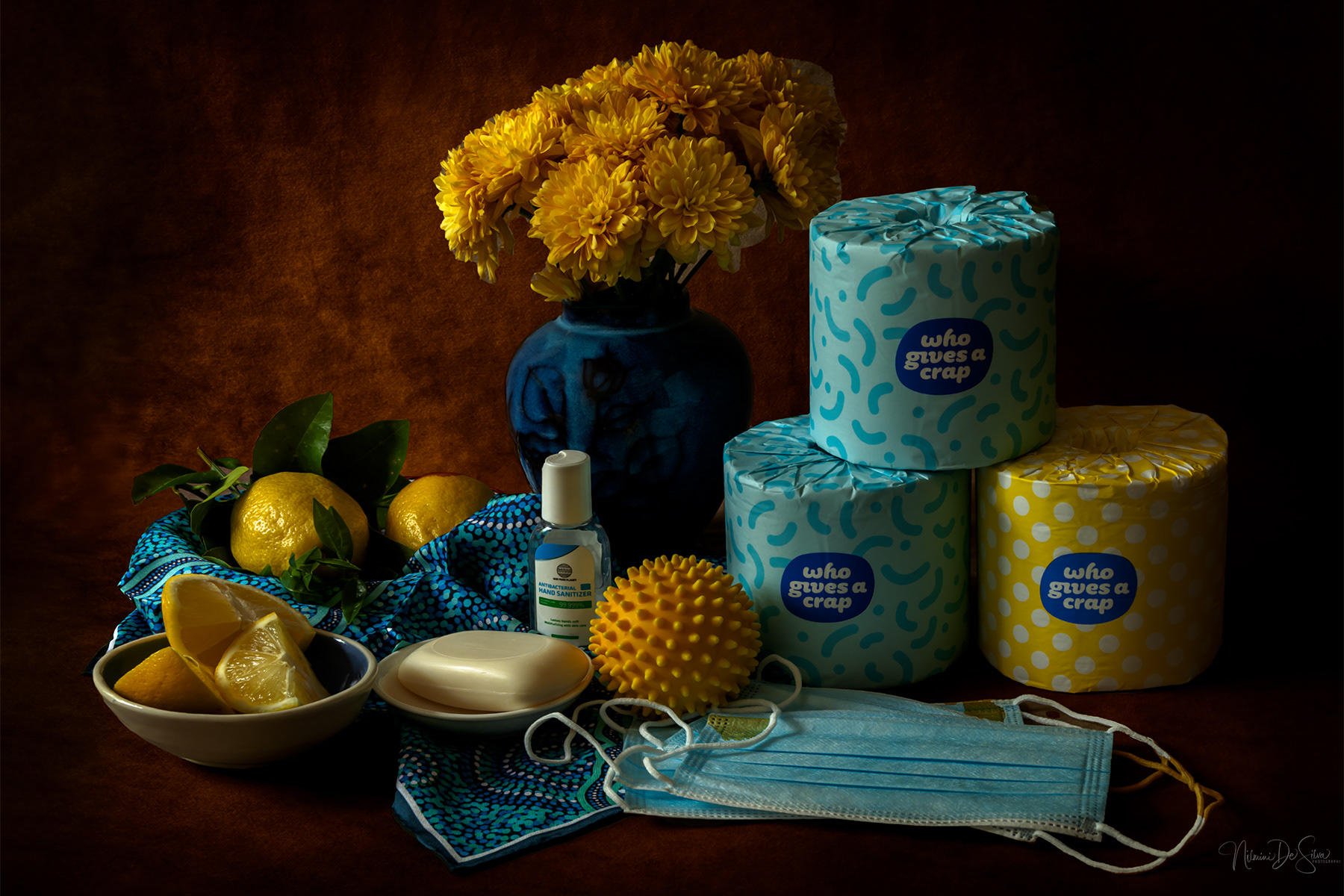
How Still Life Found Me
In the quiet of lockdown, with my camera set up on the kitchen table and a handful of wildflowers in a jar, I began to notice how much meaning could live inside the smallest arrangements.
Still life was a genre that eluded me for a long time. Defined simply, it depicts inanimate subject matter—everyday objects that may be natural (food, flowers, animals) or man-made (books, vases, jewellery). On the surface, it seems quiet, even uneventful. For years, I overlooked it entirely, perhaps because I thought I wasn’t creative enough.
That changed during the 2020 COVID lockdowns in Sydney, when time slowed and the world grew smaller. Confined to home, I began experimenting with wildflowers growing at the edge of my garden. Around the same time, I visited the Van Gogh exhibition in Sydney as restrictions were eased. I remember being drawn to his use of yellow—so often associated with hope and optimism—and realising that I was searching for both.
A Brief History of Still Life (and Why It Matters)
As I began to explore still life, I found myself drawn into its history. In the 17th century, the French Academy established a hierarchy of art genres, placing historical and religious painting at the top, followed by portraiture, scenes of daily life, landscapes—and finally, still life at the very bottom.
Ironically, the old masters understood something essential: to excel in the higher genres, artists first needed to master the lowest. Still life was everywhere. It trained the eye to see light, texture, form, and composition.
Perhaps that’s why still life finally made sense to me during lockdown, when movement halted and life itself felt suspended. One of the great gifts of still life is its accessibility. You can use what’s around you. No expensive lenses or models are required—though if you fall in love with the genre, you may find yourself wandering op shops and markets in search of the perfect prop.
Found Objects and Hidden Histories
If you’ve followed my writing, you’ll know that I’ve recently begun a collaboration with a sheep station in Western NSW. Farming properties are extraordinary places for still life. Callubri Station, a fourth‑generation working property, has a renovated shearing shed filled with memorabilia.
Within that shed, every object hums with history. Rusted blades, weathered tables, dust‑dull lanterns—each bears witness to generations who passed through the space. Time has left its mark, and that is precisely what makes these objects special. Cobwebs and dust add atmosphere and texture. Saddles and iron horseshoes hint at the horses that once moved through the shed.
These artefacts tell stories of work, resilience, and everyday life from a time long past. Standing there, I feel like a child in a candy store, surrounded by stories waiting to be told.
Learning to See What Was Always There
Still life asks us to take ordinary objects and make them feel significant. It requires slowing down and becoming deliberate—thinking carefully about composition, colour, texture, and light.
For a long time, I was puzzled by the term *still life*. How could life be still? I later learned that the phrase comes from the French *nature morte*, meaning “dead nature”: something drawn from life (flowers, fruit) paired with something inanimate or no longer living (a vase, a table).
And yet, those wildflowers—cut from my garden—will also pass. At its core, still life reminds us of impermanence. If life is to endure, it must be recorded.
Van Gogh once said, *“I dream of painting and then I paint my dream.”* That sentiment resonates deeply with my own journey.
The Practice: Composition, Experimentation, and Time
My still life journey began with a desire to immortalise my spring garden. I placed wildflowers in a vase and moved them around my house—near a window, on the deck, against a backdrop—watching how the light and mood shifted.
Still life demands experimentation. Composition, light, and post‑processing all play a role, but so does intention. As I progressed, I began leaving arrangements in place for days, returning to adjust, rearrange, and re‑shoot. Each version carried a different feeling.
Rarely does everything sit at the same level in a still life. Books, cutting boards, and other props help build depth and structure. Colour, too, is essential. Some images are layered and vibrant; others are restrained—a single object, one or two tones, nothing more.
Shaping Light: From Window to Chiaroscuro
At home, I often work with simple tools—window light, a flashlight, or basic studio lights. Many still life images rely on moody natural light shaped by foam boards or surrounding objects.
Shearing sheds are perfect for this. Light slips through windows, cracks in walls, and gaps in roofing, creating natural drama reminiscent of the old masters.
This approach echoes *chiaroscuro*, an Italian term meaning “light‑dark,” popularised during the Renaissance and Baroque periods by artists like Caravaggio. In photography, we often see its influence in what we call Rembrandt lighting.
By directing light to a specific part of the scene and exposing for the highlights, depth and dimensionality emerge.
Listening to the Images
Still life is deceptively hard. Teaching or writing about how to do it, is harder still.
It isn’t primarily about process or technique. It’s about listening—to the image, to the objects, to yourself—to discover what feels right. It requires careful consideration of what belongs in the frame and what must be left out.
You can’t teach someone what feels right to them. You can only create the conditions where that recognition might occur.
Still life is a practice of attention and intimacy. It demands patience, vulnerability, and trust in intuition. It is deeply solitary—almost meditative. I lose myself in the process in much the same way I do when photographing a sunrise.
Perhaps with time and maturity, I’ve learned how to listen more closely—to my inner self and to the spaces I inhabit. How to communicate that remains something I am still grappling with.
The Story of Bread
Last year I photographed the wheat harvest at Callubri Station. Angie Armstrong, the farmer’s wife gave me some ornamental wheat amongst other treats to take home with me. After learning that the wheat grown in Australia is shipped around the world to make bread, pasta and noodles, I started constructing images that told these stories.
Wheat cut from the land, grain transformed by labour, and finally something sustenance-giving and familiar. Bread is one of the most ordinary objects we know, and yet it carries the weight of time, work, weather, and human hands. Stories that most people will never know.
Seen as still life, bread becomes a quiet record of transformation. It speaks of cycles—growth, harvest, rest—and of how something fleeting can be made meaningful simply by being attended to. In photographing it, I realised I was drawn to the same questions that first led me to still life: how time leaves its trace, and how the everyday can hold deep significance when we pause long enough to look.
Nothing Is Ordinary Once You Truly Look
In my own practice, I return again and again to the same arrangement, shooting from different perspectives—top‑down, straight‑on, close, and wide. I leave setups overnight and revisit them the next day. I ask my partner for his opinion. I sit with uncertainty.
Still life has taught me this: nothing is ordinary once you decide to truly look.
“It is not a matter of painting life. It’s a matter of giving life to a painting.” — Richard Diebenkorn